Silent Bob Speaks

Jsbstash_1909_431813As anyone who’s ever read my bio knows, the movies of Kevin Smith factor strongly into my pop culture experience. Clerks, Chasing Amy, Dogma (yes, even Mallrats) sit proudly in my “top 10” movie list. I find them funny, thoughtful, insightful, and refreshingly willing to challenge the more taboo societal conventions. And Smith is a brilliant writer.

Smith’s most recent movie, Clerks 2, opened on July 21, 2006, in theatres in the U.S. He videoblogged the entire making of the film (“come watch the train wreck!”), and even rolled the names of 10,000 MySpace “friends” of the film during its theatrical credits.

He so totally gets it.

Smith also knows that he appeals to a limited demographic. So, he built the business plan for the film around that understanding. Smith (on July 23rd, near the end of the film’s opening weekend):

“Reuters writes “Kevin Smith’s ‘Clerks II’ was No. 6 with $9.6 million, broadly in line with expectations.”
I’m not gonna try to spin it for you: we’d have liked to have opened better, naturally.

And yet, I’m happy.

Let’s get the business stuff out of the way first…

Once again, in what’s been termed by some box office analysts as the “Star Trek”-Effect, we saw good Friday numbers dip on Saturday. Essentially, the hardest of hardcore fans show up in full-force on opening day, inflating the returns slightly, leaving Saturday to drop rather than enjoy the standard jump most flicks enjoy on the same day. So while it would’ve been nice to have done our best opening weekend ever with “Clerks II” (that 11 million “Strike Back” bar didn’t seem all that high to reach on Friday night), alas, it’s number six for us.

I can’t find anything to complain about; I mean, we nearly doubled our budget in the opening weekend. And while there were marketing costs (prints and advertising) beyond the negative cost ($5mil production budget) , they were pretty modest (indeed, we spent far less opening “Clerks II” than we did to open “Strike Back”). The flick should manage to get to $20 – $25mil theatrically, and eke out a minor theatrical profit, leaving all the DVD loot as total windfall.

In essence, we took the “Strike Back” paradigm, plugged in different, lower numbers, and are seeing pretty much the same results. But since “Strike Back” was a pretty profitable endeavor when all was said and done, “Clerks II” will be even moreso (a twenty million dollar budget vs. the five million dollar budget). Financially, it’ll be a winner for all involved.”

He also nailed the marketing of the film. Smith again:

“We knew we were going after a niche audience and spent accordingly.

That’s why we only spent five million bucks making the flick in the first place.

That’s why we spent 45 weeks throwing up making-of video blogs over at www.clerks2.com.

That’s why I did a fifteen city tour promoting the flick to every local news outlet I could hit.

That’s why Jeff Anderson and Brian O’Halloran did the same, in fifteen other cities.

That’s why Rosario Dawson and I did couch duty, separately, on Leno, Conan, Kimmel, Ferguson, and Regis (yes, Regis).

We maximized what little we had to promote the flick with good ol’ fashioned grass roots marketing: because our marketing budget was well below average.”

Back on July 23, per the quote above, Smith estimated that “the flick should manage to get to $20 – $25mil theatrically.” As of yesterday, Clerks II had grossed 22.3 million in box office revenues. Again, he nailed it.

The moral I see?

  • Know what game you’re playing, cold. Don’t self-delude.
  • Know your audience and customers. Build a business that serves them.
  • And don’t ever, ever pretend to be something you’re not.

A Trend? I Hope So.

My cynicism in some aspects of humanity has been beaten back this morning, just a little.

  • JP is writing about trust and relationships, and how they are affected, enabled, or hindered by technology.
  • Stowe writes perhaps his most thought-full post ever, and states, beautifully, “Most of the time we tech bloggers never take our eyes off the tech in the foreground to even acknowledge the world behind, forming the background. Today, it’s the context that is dominating my thoughts: the sputtering economy, the world tearing its own throat like a rabid and double-jointed carnivore, the deaths, the bombs, the inexorable heat, the rising costs… and meanwhile a bright and shiny tech culture skips above the surface of that boiling sea of trouble, like a child’s balloon rising above a troubled city: a beacon or a toy?”

  • Grace answers Victoria’s Craigslist ad, and the two jointly create a resource that helped hundreds, maybe thousands, of individuals affected by Hurricane Katrina.

  • Euen notes “Who knows, maybe out of all of these conversations and exchange of ideas that blogging has enabled we will some day tackle the really big stuff. The stuff that matters. How we run ourselves and conduct ourselves in the world. It may not be any one particular group and certainly unlikely to be some sort of “killer app.” but I am more and more confident that the connected worldview that we are fostering is different from what we have experienced before and certainly affords us a new means of expressing ourselves and making our views known. Maybe we will be able to regain some of the ground lost to those who see life as a fight which has to be won and polarise everything into black and white maybe the middle has something to add after all.”

Have a good Sunday, everyone.

And Offline, Too

Dhiraj Gupta: “Customers want to be heard, acknowledged and rewarded. They know what they want, they want to do it their own way, and that too, without talking to the customer support hotline. This rebuilding of Trust is the key to building a successful business, online.”

The One Where JP Speaks Eloquently Regarding Trust

JP writes:

“Pretty much every serious argument we’re having, every conversation we need to continue, is about some form of Big versus some form of Small. Blefuscu versus Lilliput. And we use concepts like expertise and authenticity and reliability and affordability and freedom and choice to try and win the arguments. And the concepts we use land up polarising the debates. Which made me think….
…..It’s all about trust.

The Cluetrain markets-are-conversations-are-relationships is about trust.

Hugh’s microbrands are about trust.

Tara’s It’s-Not-An-Us-Versus-Them is about trust.

The journalist-versus-blogger debates are all about trust.

Trust used to be something that bound small groups together. Over time we tried to scale trust. It didn’t scale. And what happened instead was Big Everything. In an Assembly-Line meets Broadcast world.
Big Everything broke trust. Big Media lied. Big Content Producer reduced our choices. Big Pipe and Big Device reduced it further. Big Firm wrongsized away. And Big Government did what it liked.

Trust broke.

Now, with the web and with communities and with social software and with the inheritance of Moore and Metcalfe, we’ve had a chance to rebuild trust.”

Bingo. (Not the clown-o.)

This echoes what I’ve been saying for a long time. A while back, this came out of the keyboard, as part of an internal email thread here at Cerado:

Problem #1: Customers have lost trust in traditional sales, marketing and service (CRM). “The most credible source of information about a company is now ‘a person like me,’ which has risen dramatically to surpass doctors and academic experts for the first time,” according to the seventh annual Edelman Trust Barometer. The survey relates that in the U.S., trust in “a person like me” increased from 20% in 2003 to 68% today.

Problem #2: Products, processes and infrastructure all commoditize. People and execution are the only ways to differentiate long-term.

Therefore: the foundation of trust is now in “people like me.” The foundation of differentiation is ALSO in people.

Now, there are a series of market forces at work, in the form of the various social technologies … blogs, wikis, and social networks. We’ve seen the changes the customer-driven / consumer generated forces have driven into the media industries, whether it be print, radio, or video. Now, these same social customer forces are coming to bear on sales, marketing and support.

What does this mean? This means that now, organizations now have these social tools to put the humanity back into business to solve the trust problem. In other words, the organizations that will win are the ones that most easily enable customers to build relationships and communities with people they trust.

JP, in your post, you asked for flames.

Nope. Sorry, man. Not going to get any from this quarter.

Mr. Rivera, Tear Down This Wall!

The aftershocks of BlogHer rumble through the blogosphere…the confidence, the insights, the diversity, (and even the vitriol and invective), 700++ voices from the individuals who were there, as well as the multitudes who followed the conference online. It would be easy to say that last year’s question…”Where Are The Women Bloggers?”…had been conclusively and definitively answered.

Unfortunately, that’s not the case.

On a lark, I took a peek over at TechMeme this morning. This is what I found:

Techmeme2blogher

That’s right. Five of the seven connected posts (71.4%, if my math is right) were by guys…yet, as Christine notes, 88.9% of the attendees at the conference were women.

I know (or at least I hope) that this kind of bias (def’n 3: “statistical sampling or testing error caused by systematically favoring some outcomes over others”) isn’t something that Gabe Rivera has intentionally built into TechMeme. Yet, it appears Mena’s point was spot-on.

How to fix this? Unfortunately, I think as a result of power law dynamics, there may always be the opportunity for these kinds of biases to become systemic in the tools. As a result, yes, we need to make better tools. But, more importantly, we need to make an individual effort not to just rely on the “Top 10” or “Top 100” lists, and instead get outside of our comfort zones and intentionally discover new voices and listen. (This echoes what I wrote about after the 2005 BlogHer conference. It’s still true.)

Now, I’m going to game the system, link to Dave’s post (yes, reinforcing the problem in the short term), yet hopefully drawing some notice to the issue so that future iterations of tools address this more effectively.

Some Thoughts On Conference Marketing

Back from two phenomenal days at BlogHer, and now starting to digest some of the things that I’d noticed over the weekend. First off, the right and wrong ways to market at a conference. Some thoughts from the Odd Time Signatures blog:

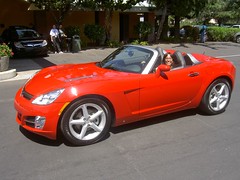
“I do, however, remember the sponsors of Blogher 2006, because they made their products relevant. Until Friday, the only car I was considering to replace one of our ancient jalopies was a Toyota Prius. Post-Blogher, Saturns are very much a part of my horizons, because GM got it exactly right. Give us the keys, let us test drive it, and if we like it we’ll buy it, talk about it, recommend it to our friends, give word of mouth/blog the power it deserves. They really got it right and they deserve many positive BlogHer mentions. I hope they sell a ton of Sky cars, and hope even more one of them is sold to me. GM/Saturn gets my vote as the sponsor who got it the mostest. They rocked.”

I’d have to agree. GM did three things right:

1) They had a noticable physical presence (a half-dozen parking spaces in front of the convention center)
2) They offered an experience (a chance to drive some hot and eco-friendly vehicles)
3) They stayed the hell outta-the-way, and only interacted with those who wanted to interact with them (they didn’t impose…if you wanted to interact, they welcomed you with open arms, but did not interrupt in the slightest into the proceedings of the conference)

Contrast this to the way Microsoft handled their opportunity. Amy Gahran writes:

“Still, I had to cringe at the campy, off-target Microsoft presentation during the welcome session just a few minutes ago.

To promote its new Windows Live Spaces service, someone at Microsoft thought it would be appropriate and fun to send a couple of bouncy, bubbly, sexy, carefully scripted 20-somethings uniformed in tight t-shirts and jeans to banter giddily for about 10 minutes on home improvement. It sounded like Barbie doing ‘Tool Time’ in stereo.”

Teachermama adds:

“The corporate sponsors didn’t really seem to get who their audience was, with the Be Jane weirdness being the primary example. All around me, people were making comments about feeling like ‘Math is hard’ Barbie was up on stage talking WAY down to us. Here’s a hint: if you’re facing a ballroom full of hundreds of smart, tech-savvy women, ‘home improvement is scary’ isn’t the way to our hearts.”

What other things did you see at BlogHer (or other conferences) where the sponsors either did something very, very right or horribly, horribly wrong?

(photo credits: socalmom and the right conversation)

Size Natters

BlogHer ’06 had 700+ attendees on Day 2. Daniel Terdiman writes:

“In what might be the largest-ever event of its kind, hundreds of women bloggers will gather here Friday and Saturday for the second annual BlogHer conference.”

So, now I’m stumped. Forget the “of it’s kind” qualifier — is BlogHer the largest blogging conference, period?

(If’n I remember, BloggerCon III back in 2004 was about 350 attendees or so, and BloggerCon IV a few weeks ago was maybe half that…)