That Annoying Scorch Of Re-entry

Oh, man. Helluva week. After the new powder beginning of the week, the skies cleared and midweek was ridiculous…postcard-blue skies and springtime temps from first run to last. Tweaked a knee in a futile attempt to keep up with she who skis too fast on Silverado (what the hell was I thinking?), but other than that, no major injuries. The offspring all had fun. Many Cuba Libres were consumed. Aaaaah.

Now for the draining of the email / RSS / podcast queues…

A Brand Is A Place, Not A Thing

Hugh writes:

“A brand is a place, not a thing. (i.e. A place where people gather and do wonderful things.)”

Agreed. Strongly.

Let’s roll with this, especially in the context of the relationship hub discussion. First off, let’s get this out in the open: it’s the customer’s choice whether he or she wants to visit any of these “places,” and it’s the customer’s choice what happens once he or she gets there.

Now, that being said, it seems to me that there are three ways for this “place” to spring into existence.

  • The vendor/brand can provide a venue that the customer may visit. Vendor-driven users groups are a great example. Online communities are another. A corporate blog is yet another. Example: RUG. (disclosure: we’ve done some work with these folks in the past)
  • A social customer may create a venue like this or this or this. Smart companies will show up at the customer’s door and jump right in to the conversation. As noted a number of times previously, David S. does this really well (check the comments here when Jason C. teed off on Technorati).

  • A neutral venue may exist, like Epinions, where both the customers and the vendors can gather.

In no case is the “brand” in charge of the conversation at any of these venues.

Homework: Which of these three types of venues exist for your company/brand? And who from your company (anyone? anyone? Bueller?) is bellying up to the bar at each of them?

Relationship Hubs In The Long Tail

Background:


Chris Anderson
: “Everyone’s taste departs from the mainstream somewhere, and the more we explore alternatives, the more we’re drawn to them. Unfortunately, in recent decades such alternatives have been pushed to the fringes by pumped-up marketing vehicles built to order by industries that desperately need them.”

myself: “It’s about relationships. Being a customer in the long tail is not as much about acquiring the things that are unique to you. It’s about connections.”

Susan Mernit: “…web-like organizations don’t fit corporate structure, so we’ll see those networks grow outside and around the new tools as they’re fitted into the mainstream–and see additional tools (maybe FOAF?) radiate out from their hub.”

Steve Gillmor: “Attention is about what we do with our time, and attention will win. Friends and family are about who we do it with, and we will all win.”

Ross Mayfield: “I almost see a new system of checks and balances between personalization (corporate interest, information-centric), customization (personal interest, information-centric) and socialization (social interest, relationship-centric) as memes lobby for attention.”

Edward Vielmetti: “…if you go far enough away from the centers of media and economic production, it’s hard to find lots of choices in the stores and in the movie theaters.”


“Imagine a crystal clear bitterly cold night in Alaska, inside a cabin with candles on the windowsill and these two guys playing for you and a bunch of friends next to the woodstove. Oh my god….”

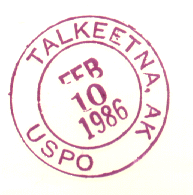
Talkeetna, Alaska has a population of 772 souls, and is a three hour drive from Anchorage (assuming the road is open and the moose aren’t rutting). In the winter, it can get down to 30 degrees below zero there. And that’s without the windchill.

There’s a tiny little cabin in Talkeetna. At 12’x12′, it’s probably smaller than your bedroom. (It’s certainly smaller than your garage.) In the winter, it’s heated with a single wood stove.

I would argue it is the heart of the Long Tail.

(now playing, Amy Rigby)

How can any place, let alone an unfinished cabin in the middle of the Alaskan tundra, be the “heart” of the Long Tail? Well, this particular cabin is ground zero for a little radio station called Whole Wheat Radio, a self-described “labor of love” according to its creators Jim and Esther. But, although it’s served up 2.9 million songs to over 180,000 web-based listeners, it’s not a typical “radio station” playing to a passive audience. From the WWR website:

“By definition. an automated radio broadcast is pretty boring. That’s where the listeners come in. The absolute best way to listen to Whole Wheat Radio is to keep the web site handy in your browser. We call this the WWR Listener Console. Click here to see how it looks.

Using the WWR Listener Console, listeners can…

* Get detailed information about the music being played (including photos and website links)
* Make music requests
* Communicate with each other, using a live chat window
* Type a message to be read on the air (it’s read by a synthesized voice)
* See who else is listening, and where they are from
* View an automated display of photos and pictures (and you even request a different set of images).”

It’s this community aspect, this relationship infrastructure, that makes WWR unique. There are thousands upon thousands of internet, satellite, and terrestrial radio stations. What is it about the little cabin that has not only drawn 180,000 listeners to the website, but has also convinced all these people (scroll down for the full effect) to travel to the middle of friggin’ nowhere to play guitars, sing songs and eat potato salad?

(now playing: Peter Mayer)

Whole Wheat Radio, both online and in the wilderness, is a relationship hub. It’s a nucleation site where socialization can occur, for people who have similar “music taste” vectors. Similarly, this place, and this place, and all these places are also relationship hubs in the Long Tail.

Relationship hubs are passion amplifiers. Prior to the having the ability to connect with others who also have an interest in a particular obscure topic (read “niche in the Long Tail”), we all needed to indulge our various idiosyncrasies solo. As a result, sometimes those aspects of our personalities atrophied and withered away for lack of feedback and support. No longer is this the case. The Long Tail is an opportunity for individuals to embrace our true interests and connect with others who share them.

(now playing: Big Head Todd and the Monsters)

Who’s on right now? “16 Listeners In: Seward, Alaska – Victoria, British Columbia Canada – San Rafael, California – Half Moon Bay, California – Escondido, California – Indianapolis, Indiana – Derby, Kansas – Wichita, Kansas – Burtonsville, Maryland – Tucumcari, New Mexico – Old York, New York US – Fayetteville, North Carolina – Oklahoma City, Oklahoma…“

Update:

Tim Bray and Julie Leung: “the Long Tail is actually a tangled mess of microcommunities and subcultures and tribes and hobbies and fanatics”

NASCAR Fan Bloggers Jump Into The Race

Knight Ridder Digital (KRD) property That’s Racin’ has launched a blog network. And the voice is great. One journo (the editor of That’s Racin’), one pit crew member, and two fan bloggers (read “customers”).

Reading through the site today, it blew me away on a number of fronts:

1) It’s a blog. About friggin’ NASCAR. I was skeptical; now I’m not. It’s real and passionate. It works.

2) In the four bloggers, they have 360-degree representation. The journalist. The insider. And, most importantly, the two customers who had been doing this anyway because of their love of the sport.

3) I had never realized there exists an intricate, almost Newtonian, balance between mullets and karaoke. I learned something today.

Congrats to KRD for pulling this off! More here.

A Review Of The General Motors Podcast

O no. A big miss on the new GM podcast. Representative excerpt:

“For the dreamer in all of us…(dramatic pause)…this is the 2006 Buick Lucerne.” (cue cheesy music, which sounds a little bit like Apocalyptica)

Ungood. Five minutes of corporate dronology. I much prefer Lutz’s blogging, which sounds human.

UPDATE:

Michael Wiley (GM Communications, Director, New Media) responds:

“Sorry you and Shel did not like the GM podcast. We understand that a press conference is not the ideal format for a podcast but we do have enthusiasts that want to hear these sorts of things. That is why we webcast them as well.

Also, since we’re in new territory, I don’t think there is a template of what is right or wrong, everything is niche oriented and this niche obviously wasn’t for you.

But, we are asking readers of FastLane what it is they would like to hear more of, and through constructive feedback we will hopefully produce something that appeals to you guys. We’re by no means limiting ourselves to press conferences.”

Conversation continues in the comments.

Customer-Centric Cuban

A couple of nuggets from Mark Cuban’s recent post, “Need A Job?” After spending a couple of ‘graphs slagging on sports marketing majors, Cuban states “it’s more important to know how our customers’ businesses operate than how the sports business operates.” ::ears perk up::

He then proceeds to advise the following for anyone wanting to get into his business: “If you can sell, you can get a job – anywhere, anytime.

At this point, I’m of course expecting a Alec Billy Stephen Fluffy (no, it was Alec, I get get ’em all confused) Baldwinesque rant like the one from Glengarry Glen Ross. Instead, Cuban offers a litany of good sense and spot-on recommendations. Three pull quotes of note:

“Let me be clear that it’s not the person who can talk someone into anything. It’s not the hustler who is a smooth talker. The best salespeople are the ones who put themselves in their customer’s shoes and provide a solution that makes the customer happy.”

“The best salesperson is the one who takes immense satisfaction from the satisfaction their customer gets.”

“The best salesperson is the one the customer trusts and never has to question.”

In other words, invest the time to understand, converse, and connect – truthfully – with the customer through empathy, integrity, and understanding. Practice actual relationship-building.

Right on.

(hat tip: Trevor Cook)