One of the sessions at yesterday’s Consortium summit was an Open Space. This particular conversation was on the topic "How can our company involve the customers more fully in creation and adding content to our [customer support] knowledge base? What are the risks? What are the benefits?"
I tore a page (an admittedly clumsy page, but if you don’t try you can’t improve…) from the Eileen Clegg school of notetaking/journaling; the results of which are included below. So. The high points, in a mostly stream-of-consciousness form…
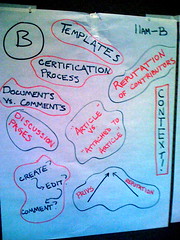
The conversation centered around how to enable customers to contribute more fully to a collaborative workspace that is shared between a company and its stakeholders, primarily centered on the support and service functions.
– Templates were suggested as a means to make it easier to customers to contribute. That is, instead of starting with a blank page (we were primarily talking about wikis as the collaboration mechanism), templated, more structured pages may encourage participation.
– Should customers be encouraged to create entire "documents" to contribute or, perhaps at the outset, is allowing "commenting" on existing documents an easier path? Are there varying methods of collaboration – creation, editing, commenting, etc.?
– Context is key.
– Is there a "certification" process? That is, if an individual has invested the time and energy to be "certified" in a particular domain, does that individual obtain more advanced privileges in the community with respect to contribution?
– Contribution privileges may be granted with increased reputation in the community
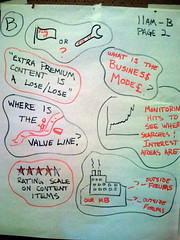
– "Flag it" or "Fix it"…Dave Kay asked the very relevant question of whether a customer should be "flagging" content that needed further attention (e.g. how flagging is done on Craigslist) or should that customer be "fixing" things that needed attention (a la Wikipedia).
– "Extra premium" content is a lose/lose (Exhibit A: The about-face of Times Select)
– Let customers rate support content
– Watching what is actually being searched on is a great driver to highlight the most relevant information
– The best information that is most useful to customers might not live within the walled garden
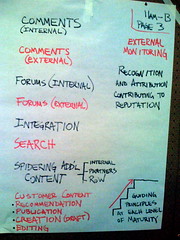
The group also brainstormed a number of different ways customers and service professionals within the organization could collaborate online. These methods included:
– Comments (both visible internal to the organization as well as externally)
– Forums
– Integration across multiple support mechanisms (e.g. integrating forums and the knowledge base)
– Search
– Recognition and attribution contributing to the reputation of a customer in the system
– Differing levels of "spidering" of content could encompass internal, partner or Rest of World sources of information
– Not losing sight of the fact that the best material will likely be outside the firewall — realize that external monitoring is ultimately critical to success