No Soup For You!

A missive from the “sales follies” department. Joel Snyder, from NetworkWorld, was trying to help a consulting client of his choose an email security system. One of the vendors under consideration at the time was CipherTrust, and Joel was going to purchase a number of systems in order to evaluate them firsthand prior to making a final recommendation to his client.

Here’s what happened:

Joel: “The salesperson was ready to give us a local value-added reseller (VAR) so we could buy the $5,000 unit. But then he passed me over to CipherTrust PR, which passed me over to the vice president of sales, who passed me to a fourth person so we could apply to be a member of their partner program. This was getting ridiculous, so I explained again that I simply wanted to buy a box for my own company to use. This time, silence. No reply.

After waiting a week, I found a VAR and ordered a system. Then the VAR called back: CipherTrust refused to fill the order. Why is CipherTrust unwilling to sell me a box? I don’t know; they aren’t talking.

More frightening than my experience is the possibility that the company might do this to an existing customer. What good is a security product if the vendor refuses to sell you service on it? Without updates, most of these products are barely useful as doorstops.

In our tests, we look at products, not companies. Things such as training, finances and corporate style don’t come into it. But when it comes to buying products, our tests aren’t enough. It’s important to investigate all those peripheral aspects of the vendor before you sign a purchase order. I was reminded of that the hard way. (emphasis added)

Here’s the full story.

Any other good stories out there of cases where a vendor simply chose not to show up?

(hat tip: mike)

The “Let’s Not Look Stupid” Test

In a riff instigated by the previous post, commenter Steve over at Tame The Web adds his entry to Guy’s list. Steve:

“I would add:

Find the barriers to customer service and knock them down.

Eliminate policies and procedures that don’t pass the “Let’s not look stupid.” test.”

The “Let’s Not Look Stupid” test is the seed of all of the cookie-cutter, undifferentiated, commodified “messages” that pummel us every day. Another way to say it: “If BigGiganticCo is doing it, it must be ok for us to do it as well.” This applies to marketing, infrastructure purchases, business models, etc.

Take the risk. Do something creative. Companies are made up of people. And people sometimes look stupid.

That’s ok.

Your customers will forgive (and perhaps even embrace) that humanity.

Devil’s Slide Living Up To Its Name

Devil’s Slide is a Ferrari-ad-worthy stretch of CA Highway 1, on the Pacific Coast between San Francsico and Half Moon Bay. It clings to the cliffs, a few hundred feet above the Pacific. On sunny days, it’s nothing short of stunning. When the fog hits, it’s the perfect Stephen King backdrop.

Over the weekend, a number of things started to, well, slide. Barry Parr has the coverage here. Highway 1 is now closed, indefinitely, between Montara and Pacifica.

For those into the whole schadenfreude thing, we set up a wiki to capture drive times between various points on the Coastside.

Barry and Darin Boville are doing a phenomenal job covering this. Check out Darin’s video, below. (This was shot yesterday, April 5, 2006.)

Devilsslidevideo

(photo credit: coastsider)

And A Benevolent Dictator At That

Will writes:

“when i’m boss of the universe . . .

Two words I’d like to remove from the Universe:

deets – The word is “Details,” not “deets.” “deet” is an important ingredient in insect repellent.

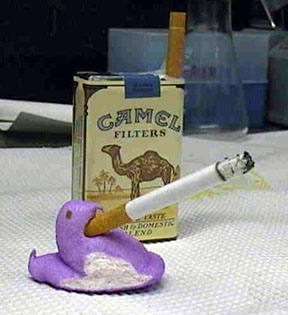
peeped – Did you look at it? Then you saw it. You did not “peep” it. And your friends? They are your friends. They are not your “peeps.” Your “peeps” are tasty little marshmallow chunks, shaped like birds and covered with enough sugar to give you type 2 diabetes after one box. They are especially tasty if you let them reach the perfect point of almost-too-stale before eating them.”

Heh. (And any post with Peeps in it is all right with me.)

Lame, But Lame

In a post entitled “Lame, But Smart,” Nick Carr writes:

“On the other hand, I think it provides a fair overview of the various ways that corporate bloggers can get their companies into hot water – even without meaning to. Corporate blogs are corporate speech; there’s no way around that.”

He then goes to reprint a list of the “legal risks inherent in employee blogging.” This list includes things such as:

  • Defamation and Privacy Torts. Companies may be held liable if their employees post content to the corporate blog that defames or invades the privacy of third parties. The company and employee in question would then need to look for the assistance of a California defamation lawyer or another legal team that also specializes in defamation.
  • Intellectual Property Infringement. Posts that include a third party’s intellectual property, such as copyrighted material or trademarks, may expose the company to liability for infringement.
  • Gun-Jumping. While a company is in registration, statements made on a company blog “hyping” the company could be deemed a prohibited offer of the company’s securities, in violation of federal securities laws.

Nick, corporate speech is corporate speech, isn’t it? It doesn’t matter if it’s on a blog or not. It could be in email. It could be in a memo. It could be in a public, oral presentation done by the CEO. When Salesforce.com’s IPO got pushed back (multiple times, if memory serves), it was due to statements that Marc Benioff made in the press and in public, not in a blog. Tying the points above to blogging is a red herring; it’s off-base and sensationalist.

A professional, acting in a sensible manner, will avoid the “risks of blogging” in the exact same way he or she would when speaking at a conference, or when speaking to a reporter, or when creating a document. Singling out the points above as “risks of blogging” is unneccessarily focusing on the medium; the real issue is in the message.

Congrats To Coghead On Their First Round Funding

FINALLY can talk about this.

Paul McNamara, Greg Olsen and the rest of the team have had a big day. (Paul and Greg are the ones who generated the “Going Bedouin” concept that’s been buzzing around the last few weeks.) Big news today on two fronts:

1) They announced the new name of their company: Coghead. Love it? Hate it? Tell ’em here.

2) Coghead has announced $3.2 million in first round funding from El Dorado Ventures.

Congrats again, guys! Check out their new site here.

It Looks Like Moore’s Law Applies To Personal Hygiene, Too

The Economist writes: “It took a leisurely 70 years after King Gillette invented the safety razor for someone to come up with the idea that twin blades might be—or, at least sell—better. Since then, the pace of change has accelerated, as blade after blade has been added to razors in an attempt to tech-up the “shaving experience”.

For the most cynical shavers, this evolution is mere marketing. Twin blades seemed plausible. Three were a bit unlikely. Four, ridiculous. And five seems beyond the pale.”

Read the whole thing here.

(hat tip: Mike Yamamoto)

On Disclosure, Transparency and Ethics

We started out talking about cell phones, and somehow have ended up at the foundations of right and wrong. NetworkWorld’s Paul McNamara writes about Sprint’s promotion originally discussed here.

McNamara:“Sprint didn’t ask me to be an ambassador. Perhaps that’s because my blog is new. Or maybe the company is savvy enough to realize that professional journalist-bloggers operate under ethical restrictions that generally preclude accepting freebies. (Or maybe it’s the fact that my blog is, ahem, relatively undiscovered.)
Whatever the reason, it was never going to be.

But reading the posts written by Carfi and Dowdell did get me to thinking: Might it be time to rethink those ethical restrictions that would have forced me to decline the invitation Sprint never offered? I mean Carfi demonstrated quite emphatically that a credible voice cannot be bought for the price of a free cell phone.

Shouldn’t professional journalists be afforded the same benefit of the doubt by their bosses and readers?

The mere suggestion will be considered heresy by many a journalist — and they’ll have a good case. After all, credibility is everything in this business and we have enough challenges maintaining it without adding on another.”

Here’s my disclosure: I strongly feel that, ultimately, these issues fall to the individual. A typical code of ethics (here’s a snippet from the New York Times) states:

“Staff members and those on assignment for us may not accept anything that could be construed as a payment for favorable coverage or for avoiding unfavorable coverage. They may not accept gifts, tickets, discounts, reimbursements or other benefits from individuals or organizations covered (or likely to be covered) by their newsroom. Gifts should be returned with a polite explanation; perishable gifts may instead be given to charity, also with a note to the donor. In either case the objective of the note is, in all politeness, to discourage future gifts.”

The Times assumes that neutrality can’t be maintained. Or, perhaps more correctly, it feels that readers may assume that any good words (or the lack of bad words) are a result of a perquisite, and not the true feelings of the writer.

Perhaps it is time for this thinking to evolve a bit. We all have printing presses now, and every one of us has a point of view that is colored by our experiences. That is a fact. In some cases, those experiences are geographic and cultural; they are the experiences of the environments in which we live. In other cases, those experiences are interpersonal; they are the results of shared time with friends and colleagues, or perhaps a debate with someone with whom we disagree. What if, instead of trying to achieve objectivity (which is a fool’s errand), we instead disclose the items that we realize are forming the bases of our opinions?

Jay Rosen writes:

“I used to teach that the ethics of journalism, American-style, could be found in the codes, practices and rule-governed behavior that our press lived by. Now I think you have to start further back, with beliefs way more fundamental than: “avoid conflicts of interest in reporting the news.” If you teach journalism ethics too near the surface of the practice, you end up with superficial journalists.

The ethics of journalism begin with propositions like: the world is basically intelligible if we have accurate reports about it; public opinion exists and ought to be listened to; through the observation of events we can grasp patterns and causes underneath them; the circle of people who know how things work should be enlarged; there is something called “the public record” and news adds itself meaningfully to it; more information is good for it leads to greater awareness, which is also good; stories about strangers have morals and we need to hear them, and so on. These are the ethics I would teach first.”

and David Weinberger expounds:

“Is there something we can meaningfully refer to as “the public record,” as Jay says?

The Public Record (caps, singular and definite article) has become A Record Filtered by the Incumbents. We now also have a public space that is self-documenting. Now that there are also public records — plural, lower case and indefinite — The Public Record has become less authoritative, and, we hope, less authoritarian.”

It is now trivially easy for anyone — journalist, blogger, customer, neighbor — to document their experiences in words, pictures and video. There are public records and The Public Record (which can be self-correcting).

So the question: Do disclosure and transparency and personal reputation make up the foundations of a set of “new ethics” that are coming into being?

[Update: Elizabeth Albrycht is poking at a different side of this today as well, in Transparency and Possibility. And John T. Unger pushes things way ahead in the comments below.]