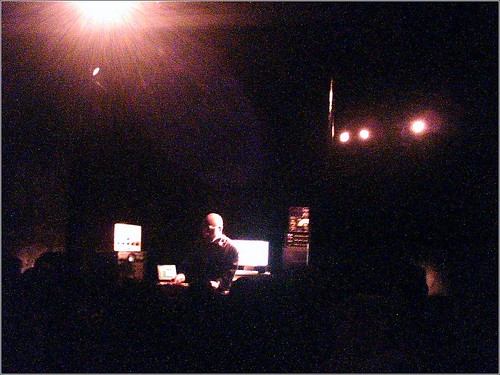
Live From The Gleacher Center

In the session at Ahead of the Curve.

Stowe just finished up a great overview on blogs, blogging and podcasting, and now Bill Flitter is just finishing his presentation. The big take-away for me … RSS is still too complex. It’s too complex to explain … too complex to subscribe … too complex to “show” what an RSS feed is … too complex to communicate how and why it matters.

Once we get beyond the early-adopter crowd, what are the capabilities and metaphors that are needed to enable RSS to become so ubiquitous that we don’t need to go through the nitty-gritty details? (In other words…I don’t want to know how the internal combustion engine operates, I just want to reliably get to my destination.) Back in August, 2005, Chris Selland wrote:

“RSS is still very much the realm of early adopters (which is why only early-adopter-focused companies like Audible, Woot and HDNet are using it). But as RSS readers become more powerful and more ubiquitous – and particularly as they become more closely entwined with e-mail applications – expect the use of RSS to dramatically accelerate – much of it at the expense of e-mail.”

This is still on-target.

Randy Moss is now up presenting the first part of the social networking discussion, and talking about directed apophenia, and leading into a group exercise. Everyone in the room is up at the front of the room, showing their connections to the others in the room, via past experiences, hobbies, hometowns, schools, products/brands they are passionate about, and the like. (By the way, Randy’s book recommendation of the day: The Hidden Power of Social Networks by Rob Cross.)

A social network visualization exercise at the Chicago AMA (American Marketing Association) meeting

Randy: “It’s critical for organizations to host communities. If a company does this, they’re the good guy, they are the one who is providing the network for individuals to connect.” (bravo!)

Michael Sevilla from Umbria is now presenting a state of the blogosphere preso. Now moving into a discussion of promoters and detractors, and is highlighting the Qwest’s Terms of Service flap. (Michael was affected by it.)

VERY interesting. Now going through things that one can do with OpinMind. For example, blog sentiment of Microsoft and Apple. (N.B. Kind of a neat tool, but it does not seem to have a deep listing of sources. Hopefully it’ll grow more over time.)

fin

(top photo: UChicago)

Thoughts For The Beginning Blogger

One of our clients is starting to charge full-force down the blogging path and asked for some feedback on the posts they were working on. Not going to get into the details of what they’re working on quite yet, but had some thoughts that I was sending over based on reading the initial bits that were being put together. About halfway through, realized that these items were fairly relevant across-the-board, so here they are. What would you add to this as far as suggestions for someone just starting down the blogging path?

“G-

First off … Every successful blog eventually has a voice and a corresponding “positioning” (sorry for the marketingspeak) that is applied to it by its readers. The voice of the blog will evolve and, just like positioning in the pure marketing sense, a “tone” of the blog will be applied to you by your subscribers. This will take some time, but if you have a feeling as to how you would *like* to be positioned, you can certainly help it along via the choice of name, categories, commonly-used phrases, etc. Think about what you want the blog’s mojo to be: is it an inside look at the tales of a startup? Is it a viewpoint and *the* reference on long-tail software, or perhaps SaaS? Something else?

Think about your blog’s tagline. (The tagline WILL be reproduced elsewhere, so try to make it capture the core of whatever theme you want to tie everything together.) If the theme is still evolving, it may take a couple of months for the right tagline to present itself…and it will probably uncerimoniously assault you in the shower in the pre-caffeinated hours one morning. But it will show up. Write it down and integrate it when it does.

The positioning and general mojo are ultimately critical…but short-term irrelevant. Just write. Then write some more. It’ll evolve, and don’t force it. It took about four months after inception for the Social Customer blog to find its voice.

Additionally, a well-conceived and executed “About” page is a must, as is a picture. A well-written post will trigger a click to the About page which will, if also well-executed, trigger a click back to the mothership. Make the About page personal. It’s you!

A couple of other general thoughts:

– More links to other blogs inlined in the text! As a result of the current state of measurement and search tools, bloggers are narcissistic link whores (it’s all about the Googlejuice, baby). The more links you throw out to others, (a) the more likely someone will come to your blog (since they saw your blog show up in their vanity feed in Technorati) and (b) they may even put a reciprocal link in one of their posts in the next week, pointing to “hey….here’s a cool article on *x*” that shows how you can use whatever they are pimping in doing *x*. If you can’t link to a blog, link to a news article. If you can’t link to a news article, link to a product site. But link! As Anthony Kiedis so eloquently put it…give it away, give it away, give it away now. (However, for the love of all that is good and right in the world, please refrain from experimenting with RHCP tube sock attire. ::shudder::)

Last, but certainly not least, make sure you have an RSS feed that can be subscribed to on Day 1. Get readers on the drip. First one’s free…

best,
c”

SXSW Reception

A few shots from last night’s SXSW Reception at 111 Minna in San Francisco. Click ’em to make them larger, etc.

click to enlarge    click to enlarge

click to enlarge    click to enlarge

(Happily, was too busy being social to take very many.)

The 111 Minna space is currently featuring an exhibition called A Year and a Day, and their archives of past exhibitions can be found here.

tags:

The Social Customer Manifesto Podcast 13JAN2006

click here to subscribe

Summary: Leif Chastaine and Christopher Carfi discuss customer challenges in switching mobile phone plans, a blogging “contest” that may be backfiring on its sponsors, Sony’s rootkit fiasco, how Thomas Hawk dealt with an unscrupulous e-commerce vendor, and a recap of the current legal challenges facing Research in Motion (RIM), maker of the ubiquitous BlackBerry device. (37:45)

Show notes for January 13, 2006

The audio file is available here (MP3, 34MB), or subscribe to our RSS feed to automatically have future shows downloaded to your MP3 player.

00:00 : Intro
01:30 : Cell phone follies
05:45 : Everyday Hogwash
11:45 : “I just want to listen to this CD!” … Real-world experiences with Sony’s rootkit
19:40 : Thomas Hawk’s PriceRitePhoto vindication
28:45 : Troubled waters for Research in Motion and their BlackBerry device
36:30 : Wrapup

Links:
Cingular and AT&T Wireless, Everyday Hogwash, Steve Rubel, Andy Beal, Sony rootkit, Thomas Hawk, NYTimes, BlackBerry troubles

Sooooooooooooey!

In a cruel twist, the first casualties of the Everyday Hogwash contest may be project’s sponsor, SunRocket, and GMD Studios, the agency driving the project. High-profile blogger Steve Rubel, who just yesterday announced that he was one of the judges of the Googlejuice machine contest, has very publicly pulled out, stating “The Everyday Hogwash contest plays into [the] ‘online lynch mob’ meme that I have been trying to refute. I am going to back out as a judge. It’s simply not consistent with how I feel about the overall balance of the blogosphere.”

Steve’s change-of heart was driven by a well-worded missive by Andy Beal, who may win the first great irony award of 2006 for his post. Beal:

“How many of you were offended with the Forbes article that labelled bloggers as an ‘online lynch mob spouting liberty but spewing lies, libel and invective.’

Well, contests like ‘Everyday Hogwash’ certainly don’t help. The contest encourages bloggers to complain about businesses in hope of winning prizes. That’s terrible.

Why do we want to encourage just the complainers? Why reinforce the negative image of bloggers? Surely the sponsor SunRocket could get the same publicity by encouraging both negative AND positive comments?

I think this reflects badly on SunRocket, so, ironically, consider this my entry to the contest.”

NYTimes: Thomas Hawk Gets Revenge Over PriceRitePhoto

Back in November, Thomas Hawk ordered a camera online from PriceRitePhoto. There were several “problems” with the order, according to PriceRitePhoto…most seemingly stemming from Thomas’s unwillingness to succumb to the pressure being put on him to buy extra memory, batteries, extended warranties, and the like. Things got heated on both sides, the fulfillment of the order was dragging on and on, and words were exchanged. Eventually, the PriceRitePhoto manager, Steve Phillips, gets into the act. Thomas:

“So today I checked on my order online again and saw that it had not been routed to shipping and called the company back again. Four times I was put on hold for a substantial amount of time and had to hang up and call the company again. Finally I was able to connect with an individual who said his name was Steve Phillips. Steve Phillips abruptly told me that the camera was out of stock. When I protested and told him that it was confirmed online yesterday and verbally by his sales rep he refused to budge.

At this point I thanked him and informed him that I would be writing an article about my experience with his company. It was at this point that he went ballistic. He first told me that if I did this that he would not cancel my order but just never fill it. If I cancelled it he said he’d charge me a 15% restocking fee. When I told him that that would be unethical he went nuts. He accused me of trying to “extort” him and said that he was going to have two local police officers come over and arrest me. He then went on to say that as a “professional photographer” I should have known better than to try and buy a camera this way and that he was an attorney and would sue me if I wrote an article about my experience.”

Thomas wrote up the story, it was picked up by Digg, BoingBoing and others, and it became a phenomenon. Again, Thomas Hawk:

“I think that the popularity of this story comes in large part because the message resonates so strongly with all of us. Although in a sense it is the classic tale of David and Goliath retold, it is much more than this. We all have at one point or another in our lives been bullied and most of us have been defrauded or ripped off. The fact that so many times in the past there was nothing we could do about it makes us feel all that much better about the fact that in today’s internet and blogosphere we actually CAN do something about it.

Out of all of this, hopefully more than anything, this story will serve as a reminder to shady businesses everywhere that in the end fraud and abusive behavior towards customers does not pay. Perhaps I’m being overly idealistic here and perhaps this incident is the smallest possible blip in the greater world of internet fraud — but one thing I do know is that the power of the consumer is growing. And in a new world today with tools like blogs and Slashdot and Digg the consumer is empowered in great ways that they never have been in the past.”

Now, in the span of just a few weeks, the story is in The New York Times (reg. req’d, excerpts here) and the PriceRitePhoto warehouse space seems to have been abandoned. Additionally, according to the article in the Times, no one has picked up PriceRitePhoto’s mail in over two months. (Note: It also appears the PriceRitePhoto has been trying to reinvent itself as Barclaysphoto on Ebay, and has also registered Barclaysphoto.com.)

Thomas, I salute you. And to all the PriceRitePhotos of the world…well, there are some dishes best served cold.

(slingshot photo: http://www.mwart.com, hat tip: jeff jarvis)

Amazon Rant

danah: “One of the things that i hate about the whole online vendors thing is that we’ve lost customer service completely. What happened to the customer is always right ethos? What happened to being really conscious of valued customers?”