Apple: The New Sony

(UPDATE!: Mac Mini unveiled.)

Oy. I was all queued up to write about someone doing something positive with their customers (check the comments; they’re awesome), and this comes across. Dan Gillmor, Om Malik, and many others are reporting that Apple has just sued Think Secret, one of their most rabid fan sites, which has been hosting rumors of a $499 iMac. Gillmor:

“I’m fairly sure of this: If the party leaking information to Think Secret had sent it, say, to the San Jose Mercury News or New York Times, and had those publications run the news, Apple wouldn’t be suing them. Both have deep enough pockets to defend themselves.”

Sony v. Kottke anyone?

So, Apple is going after Think Secret in order to plug the leaks that Apple has in its own organization. Sony is going after Kottke for information that he had gotten from a source.

EugeneCraiganyone…help us out here!

As the customer guy, this doesn’t make a whole lot of sense to me. Why go after the customers, when the root of the problem is internal? Do it once, you make a point. Do it twice, and “ok, already.” Do it three times, and it may start to put people off. In fact, this is starting to happen. From Allen George, an Apple customer:

“Many Apple fans (in this context I prefer “Apple apologists”) have sided with the company, citing dubious reasons such as ‘protecting the investors’ et. al. I disagree with their point of view.

I ask:

  • In what material way do these rumors hurt Apple?
  • Does Apple ever consider the fact that people are actually interested in their products as a result of this?
  • Why is this suit being conducted?

At any rate, this site – one of the most reliable Mac rumor sites out there – will almost certainly be shut down as a result of this. Apple’s legal department is well known for its bulldog like tenacity and ferocity, so it’s unlikely the owner will be able to stand up to their wrath.

Another example of corporate power against the ‘little guy’? I think so.

And a reason for me to actually consider _not buying_ Apple products.

[shakes head]

Why Apple why?”

MacHeads discuss the situation here.

Applying The Cluebat, Episode #742: Before Advising Your Customers To Do Something, You Might Want To Do It Yourself

Interesting bit from Steve Rubel about PR firm MWW Group‘s new “weblog marketing practice” which “will advise clients on strategies to create, participate in, monitor, and advertise in blogs,” according to MWW’s Alissa Blate.

Rubel nails it:

“Blogs are just the beginning. The bigger trend is that consumers want to have a role in talking about products and even in marketing them”

and

“Consumers are in control, and consumers are the media. It’s a paradigm shift that’s going to change PR forever. We need to be listening to bloggers as much as talking to them.”

Steve’s points are spot-on. But with respect to MWW…I am the only one that finds it really funny that MWW is doing this…and that they don’t have a blog themselves?

RealNetworks Jumps The Shark

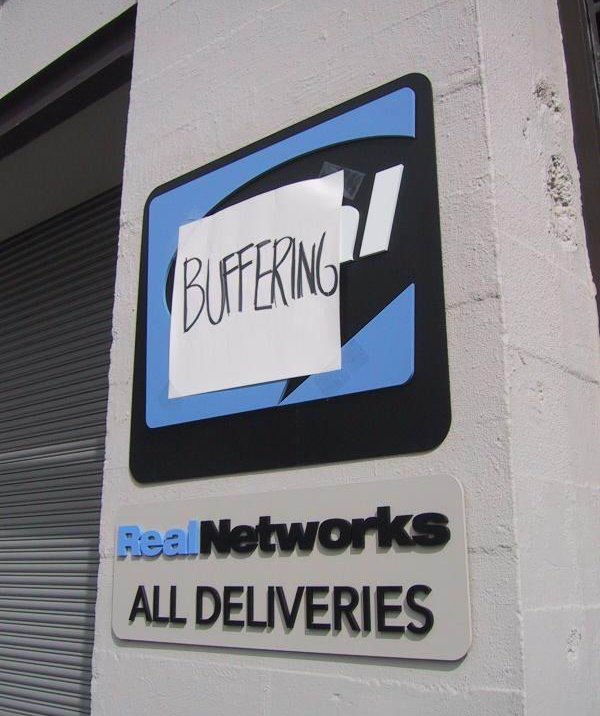
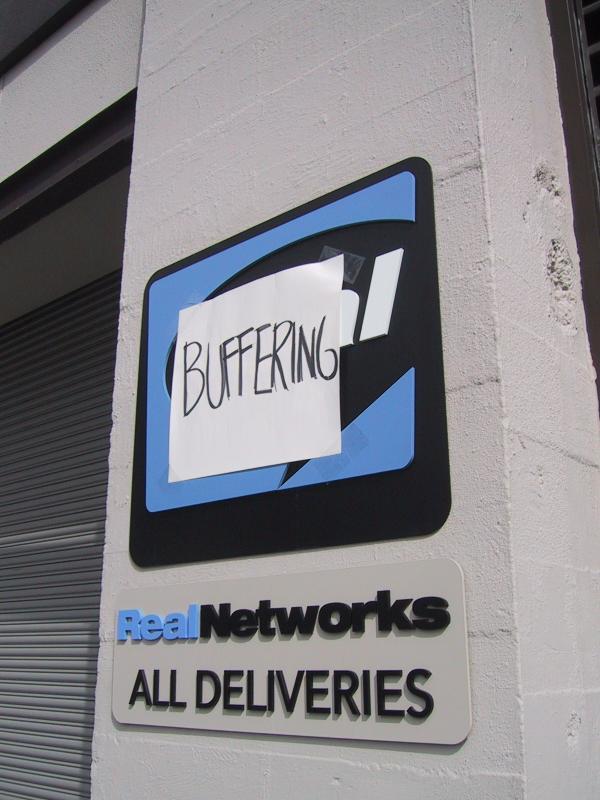
(I’d made a commitment to a certain reader a few weeks back to follow up on why Real does things the way they do.  Here’s what I found. Photo credit to Christopher Chen.)

After listening to Real’s most recent conference call, it certainly does appear that Real views its customers as a nuisance and as a necessary annoyance.  In over forty minutes of presentation and Q&A, customers were barely mentioned.  Instead, the discussion focused nearly exclusively on what Real’s competitors were doing, and on the various distribution deals that Real was landing (and losing, such as Major League Baseball).

Perhaps this is a result of some sort of Rob Glaser myopia.  In the ten years Glaser spent at Microsoft (1983-1993), he managed a number of different products, including Microsoft Word.  Locking up the channel, and wielding the power of being thrust upon customers (as opposed to being chosen by them) seems to continue to be the M.O. of Real, as it is at Microsoft.  This does not appear to be changing any time soon.

What does seem to be changing, however, is Real’s focus, which is now not only on music but other downloadable content such as games.  Real seems to realize that the audio/video space that they’ve been playing in since their inception is now crowded, and that they’ve been pushed to the sidelines in the process.  It must irk Glaser to no end that, not only was he rebuffed by Steve Jobs, but now Apple has a 70% market share of the downloadable music market that he and Real, ostensibly, pioneered.  So, in what was quite likely a move based more on emotion than sense (and probably driven by Glaser’s reported bull-in-a-china-shop personality), he decides to trump up a petition and rally Real’s customers to rail against Apple.

This was a bad idea.

Here’s the wakeup call, Rob.  Apple’s customers love them. (And the ones who don’t are at least creative about it.)  Yours don’t.  In fact, your customers former customers such as the beloved CarTalk guys from NPR have gone so far as to publicly state why they are "uncermoniously dumping RealMedia."  Here’s why:

"Why? Because, for a long time, we’ve had tons of complaints about RealNetworks. And the one that ticks us off the most is the perceived trickery they use to sell their premium products. This is just our opinion, mind you, but it’s shared by enough of our listeners, that we finally decided to take action.

Here’s the problem. In order to hear our audio, you have to go to Real.com and download their "free" RealPlayer. But when you get to the web site, the free player is harder to find than Osama Bin Laden at night. And the site seems to do everything it possibly can to get you to "buy" a player instead. You have to work very hard to get the free player. And we think that stinks. And get this. It stinks so much that it even makes Microsoft look good by comparison. That’s something, huh?"

Even when asked directly by a Slashdot reader, "Why try so hard to force your software on the user? Is it worth the market share to anger and confuse your core audience? Mention Real to the average user, and their first response is ‘I hate that software. I wish I knew how to delete it.  I’ve always been taught that it’s best to make your customers happy, instead of holding them hostage. Does your business model say otherwise?" Glaser answers in PR-speak and evades the issue, instead focusing on competitors (Microsoft in this case) and his technical team.  Glaser:

"We have put a lot of effort into making our users happy and in giving users lots of choice in how they install and use our software. We have learned a lot over the years and I think if you look at RealPlayer 10 for Windows, Mac, or Linux carefully, you would find that it gives users much more choice and control over how our player works than any other major media player, including Microsoft’s Windows Media Player or Apple’s iTunes.

While I’m not 100% sure, from your description it sounds like you have a previous version of RealPlayer. In RealPlayer 10, the user can select Tools/Preferences/Automatic Services and configure all of the background activity, including features that remain active when RP is not running. With just a couple of mouseclicks, the user can disable all background services.

Compare how our software works to Microsoft’s. Have you ever tried to "uninstall" Windows Media Player? All Windows does, in its own words, is "removes access to Windows Media Player from the Start Menu and Desktop," yet it doesn’t actually get rid of the software. If you uninstall RealPlayer, we uninstall the whole enchilada. Same with mime types: we ask you what mime types you want our player to play, and then we only play those. On the other hand, when you upgrade your version of Windows, it takes the mime types it wants to without even asking. What’s more, we’ve been told by reliable sources that Microsoft writes into its contracts with computer OEMs that the OEM MUST make Windows Media Player the default player for major mime types, otherwise the OEM doesn’t get access to critical marketing funds that every PC manufacturer needs to stay in business.

Regarding your question of why we have put the features you want on specific menus, I will ask the guy who runs our player product group to take a close look at how we can make control of the specific features you have described even more obvious. My guess would be that the tradeoff is making the features available to technical users without confusing average users. Even so, we’ll try to do even better next time. I promise that we will do our best to keep improving our software for both regular consumers and technical users. "

"We’ll try to do even better next time," says Glaser.  Good grief, man…you’re on version ten of this thing already.  You haven’t listened to customers since the company was founded.  Your marketing department is out to lunch. You make it impossible to cancel a subscription once it is started.  Your product is accused of being spyware and adware (so much so that the BBC apparently requested its own version that was malware-free).  Why should customers believe you?

Here are my predictions on where this story is going to go.  Real is going to continue to swim upstream against not only Apple and Microsoft, but also a host of others such as Buy.com in the downloadable music and video space.  They will continue to attempt to cut deals with "last mile" intermediaries such as Comcast, Earthlink, and others to get automatically installed on desktops in the gaming space.  They will work with Vodaphone, Nokia, Sprint and others to get their players as the "default" media and game players on mobile devices.  And maybe this "ignore the customer, but focus on the intermediaries" strategy will be successful for them, which will only happen if they are able to get complete lock-in, which is increasingly unlikely as other alternatives become available. 

I wonder if at some subconscious level, Glaser knows that this strategy is too broad, and opens Real up to a death by a thousand cuts from a variety of competitors.  This is almost inevitable, since he doesn’t have a customer base to back him up (as was shown by the Apple petition debacle).  Maybe that’s why he’s already picked out his next career?

Eats, Geeks, and Leaves


Neither rain, nor sleet, nor dark of night could keep the blogger crew from descending on Chaat Cafe last night. Renee Blodgett has a great writeup of the whole shebang, which migrated to Casa de Matt Mullenweg for the post dinner shenanigans (Nicole Lee captures the zeitgeist).

The whole crew*:

Robert Scoble | Steve Gillmor | Steve Sloan | Dori Smith | Farida Paramita | Michael Eakes | Dan Gould | Christopher Carfi | Masha Solorzano | Scott Rafer | Dan Farber | Lisa Canter | Marc Canter | Mimi Canter | Lucy Canter | Lyndon Wong | Ron Lichty | Tom Conrad | Marc Novakowski | Pierre Wolff | Nadeem Bitar | Kaliya Hamlin | Brian Hamlin | Ian Jones | Nicole Lee | Kevin Marks | Thomas Hawk | Neal Drumm | Tony Chang | Zack Rosen | Kieran Lal | Jasmeet Singh | Jason DeFillippo | Ian Kallen | Kevin Burton | Brad Neuberg | Renee Blodgett | Jeff Minard | Om Malik | June Parina | David Sifry | Jonas M Luster | Micah Alpern | eleanor kruszewski | Jim Grisanzio | Tantek Celik | Rebecca Eisenberg | Curtis Smolar | Russell Beattie

* – including Scoble’s jacked-up XFN tags (grin)

Can More People Be Like Doug Kaye, Please?

(mea maxima culpa for omitting the trailing “e” in Doug’s name in rev. 1 of this. Thanks to Steve for setting me straight.)

I want to know more about Doug Kaye. A quick search for “‘doug kay’+bio” brings back a paltry 23 results, only two of which relate to this Doug Kay.

I first heard about Doug Kaye at BloggerCon in November, 2004. At the same time, I heard about IT Conversations for the first time. The best summary I’ve found so far is from here:

One of the largest podcasters is Doug Kaye’s IT Conversations. Great, in-depth discussions with folks in the technology community (An awful lot of content of this nascent medium serves its geek constituency. But bloggers spent a lot of time talking about Open Source and the like before they got around to other stuff.)

Some of the most amazing content at IT Conversations is complete audio archives of important tech industry conferences: Web 2.0, PopTech, Bloggercon, Stanford’s Accelerating change and 20 others are there in their entirety, for free.

So, as best as I can tell, Doug has been helping to record, produce, and distribute this amazing body of content. And, with the exception of perhaps some help on the bandwidth side from a sponsor, he’s been doing it for the passion of what he’s doing.

Last month, he got reflective about this very fact. Kaye:

“The one question I’m asked about IT Conversations more than any other is, “What’s your business model?” After 18 months, nearly 300 programs and now with the New Year looming, the time has come to answer that question.”

Your stereotypical Silicon Valley type would start calling up VCs and bankers, and perhaps draw up a business plan for the “next generation, peer-to-peer, highly-distributed content distribution platform.”

Not Kaye. He looked left, looked right, set up a collaborative space to have a conversation, and asked his customers “what should I do?”

Kaye seeded the conversation with two broad categories:

  • Advertiser/Sponsor Revenues
  • Listener-Side Revenues

Then he let it go, and asked his customers “What do you think?

The response has been amazing. At the current time, nearly sixty responses have been given to that simple question, including a number of thoughtful replies from other folks like Ross Mayfield and Steve Gillmor both within the wiki and in the blog diaspora.

And I have a feeling as we venture not too very far into 2005, Mr. Kaye will have his answer. Cheers, Doug. Good on ya for letting the customers drive.

How Can I Trust Anything I Hear About Seth Godin? Or Anyone Else?


Yes, it’s time for another “I hate BzzAgents” rant.

I just learned that the last two books written by Seth Godin have been marketed by the evil BzzAgent machinery. This is kind of a funny, Catch-22, recursive, ouroborosian sort of situation. Seth, the marketing guy, does all sorts of “creative” things to promote his books, which are about marketing. However, in the process, although they have been marketed to the nines, I will never ever ever read one, because they are being marketed by a bunch of disingenuous folks who shill products to friends (oftentimes surreptitiously) in exchange for loot. According to their site, “…you can earn all sorts of rewards. We’ll grant you BzzPoints for your BzzActivities, which you can redeem for BzzRewards such as music, gift certificates, sports gear, movies and galley proofs of novels!”

Bzzzthp on that. Although the BzzAgent founders and website vehemently declare that their “agents” are on the up-and-up, and that honesty is encouraged, the lure of lucre — or more likely, the lure of a shortcut to some sort of feeling of mass-produced “cool” — is going to be too great.

These people, and this model, break the implied social contracts between individuals, the contracts that say “I’m interacting with you because I value you, and I value spending time with you.” Once the trust and the implicit social contract is broken, one’s antennae need to be up at all times, even moreso than before. Every Amazon review. Every worthwhile mention of a co-worker. Every mention on a website. Every interesting thing being read by a stranger at a coffee shop…are they doing these things in order to explicitly influence?

Ugh.

In some ways, it’s almost cult-like. The BzzAgent drones have defined an opaque vocabulary. (Like any other group trying to create cohesion, this acts as a shibboleth to enable the “agents” to easily identify others of their clan.) They get people to donate time, and a lot of it (5-10 hours per week) for the “privilege” of “belonging.”

Of course, the founders of the group preach “transparency!” and claim that everything is above board. However, the recent NYTimes article (reg. requ’d.) shows otherwise.

“For starters, Desjardins said, BzzAgent ”turned me on to reading.” And having enjoyed ”Purple Cow,” he wanted to do his best to spread the word. The Bzz guide suggested he call a bookstore. For a while, he put it off. He would look at the phone and tell himself, I can do this, and he would try to rehearse what he would say, and this would go on for 15 or 20 minutes. ”I thought: What have I got to lose?” he said. ”I’m never going to see this person.” And finally he called and pretended he did not know the name of Seth Godin’s new book. ”He’ll call anybody now,” Melissa said, smiling.

He printed slogans from ”Purple Cow” (”Be Remarkable or Be Invisible”) onto card stock and hung them where his fellow employees could see them. He posted reviews on Amazon. He started conversations with co-workers, customers, strangers. He submitted a rave review for a fantasy novel he was buzzing called ”Across the Nightingale Floor” to The Concord Monitor, and it was published; there’s a laminated copy of the review on the fridge. He wrote to the governor touting Mail-Block. At the grocery store, when a co-worker moaned about not liking her job, Desjardins practically turned into a motivational speaker, waving his hands and quoting from another book called ”Five Patterns of Extraordinary Careers,” telling her that if she wasn’t happy she needed to take control of the situation. ”She did end up finding another job after that,” he observed. Desjardins is ranked the 45th most effective BzzAgent, out of 60,000 nationwide, and proud of it. He has learned to influence. “

Which leads us back to Godin. According to the article:

“Godin is not just a BzzAgent fan — he’s also a client. ”Purple Cow” was marketed through BzzAgent, and Godin quietly plugs the company at the end of the book. He describes BzzAgent as a company at the center of a conversation between its corporate clients and thousands of agents who serve as a kind of guild of consumers.”

The most nauseating thing, however, is how the company promotes this sort of “pimp your family” mantra as a shining example to be emulated. From the BzzAgent site, a testimonial from one of their agents, all giddy with his success at selling out his relatives:

“As I neared the Top 10 [BzzAgents], I was excited and set my sights on bee-ing BzzAgent Numero Uno. I knew that I couldn’t casually wait for Bzz opportunities like I had in the past, but had to actively seek them out. I had a lot of success with family and friends, but now I had a better understanding of what it took to create Bzz and hook a target — influencing a person’s buying habits isn’t just as easy as bringing up a subject and diverting the conversation onto a book or other product. No, it required really finding out what made the product great and how to connect it to the target’s needs or experiences. As I got good, I began to appreciate the impact that I was having in shaping the buying habits of the people around me.

The prizes are nice — I’ve been happily rewarded — but the noticeable influence on the purchases of family, friends, and colleagues is the real reason that I enjoy bee-ing a Bzzagent. They now ask me what I think, opening the door for new Bzz, and in some cases, the product is helpful to them, and they wouldn’t have known about it otherwise, had I not brought it up. Bee-ing a Bzzagent has enabled me to reach out to people in ways that I hadn’t before.”

No thanks.

Others talking:

Ad Rants
(line of the day: “It’s all simply an ongoing, multi-billion dollar battle of wills between marketer and consumer. Marketers want eyeballs. Consumers want to tear marketer’s eyeballs from their sockets.”)

Calacanis

Church of the Customer

Tom Guarriello

Meryl

John Moore

Press Marketing

Risley Ranch

Slacker Manager

Doc Searls

NYTimes Forum

Update: The Don’t Trust List

The following organizations are companies (and individuals) known to be BzzAgent customers, based on the BzzAgent website. Caveat emptor…

Companies

  • AirTran Airways
  • Anheuser Busch
  • Coca Cola
  • Conair
  • Estee Lauder
  • First National Bank Omaha
  • General Mills
  • Kayem Foods
  • Kelloggs
  • Ralph Lauren
  • Lee Jeans
  • Johnston & Murphy
  • Mailblocks
  • Procter & Gamble
  • Radica
  • SC Johnson
  • Weight Watchers
  • The Wharton School of Business

People

  • Seth Godin
  • Tom Peters

Update 2:

Great follow-on BzzAgent commentary taking place over at Brand Autopsy. Be sure to check the comments section.

Social Networking, Competitive Intelligence Key Points For Entrepreneurs

Paul Allen, of Infobase Ventures, has posted a gauntlet of eleven things that an entrepreneur must do before approaching him for mentorship. Allen states that he is “getting more requests for mentoring from entrepreneurs than [he] can handle.” So, to ensure that everyone’s time is time well spent, he has put together his list of requirements for anyone wishing to approach him for advice. His requirements are:

  • You must be using LinkedIn.com and have at least 10 connections and 2 endorsements. That way there is a good chance that I will know someone who knows you. It will be easier for us to gain mutual trust this way.

  • If you have a management team or key employees, each of them must be on LinkedIn.com with at least 5 connections.

  • You must have an advisory board of 3 or more successful business people (preferrably 6-10) who believe in you and are willing to meet with you monthly or bi-monthly to dispense advice and help you with your challenges.

  • If your company is at revenue stage, you must be using Quickbooks Online Edition so that I can review your financials with you as needed. This costs only $19.95 per month and gives 3 users access to your data. I need to see the real picture and not just hear about the big ideas.

  • I need to see a simple cap table (showing the ownership of your company, including options and warrants)

  • You must know your company’s SIC code and have a list of any publicly traded competitors that you might have. I want you to be familiar with SEC reports and gaining competitive intelligence. Too often entrepreneurs have an idea, think they are the only one doing it, and they are unaware that there are large well-funded competitiors doing the same thing. This doesn’t mean you can’t succeed by being faster and smarter than the larger company (in business, often large=slow), but I don’t want you to be unaware of your competition.

  • If you do have publicly traded competitors, you must have a My Yahoo portfolio listing all their stock symbols, so you can stay current with their news and financial status.

  • For your privately held competitors, I need to know the Alexa rankings of their web sites and how many employees they have. (The best way to get this info is to download the Alexa toolbar.)

  • You must have set up Google Alerts so that whenever any of your competitors are in the news, you will hear about it and know what they are all up to. I want to see a complete list of your Google Alerts keywords.

  • Finally: don’t dare ask me for advice or help if you haven’t read Guy Kawasaki’s Art of the Start. I think it’s the best book ever written on startups. I expect you to have marked up every passage that struck you as important, and I expect you to have followed his formula for startups, including the MAT approach, the 10/20/30 rule for Powerpoints, and the bottoms-up business model and forecast.

  • I don’t need to read a business plan, but if you have a 1-2 page executive summary that’s okay, but certainly not required.

Let’s break this down. Out of the eleven items:

  • Four are spent on the importance of competitive intelligence.
  • Three are spent on the importance of social networking.
  • Two are spent on current finances and capitalization.
  • Only one is spent on preparation.
  • Only the final one is spent on the need for a “formal” business plan.

I would tend to agree with the breakdown of these items. Have a solid knowledge of the marketplace and who you are going up against. Have a solid network of advisors who will not only support, but also challenge. Pay attention to the numbers, but don’t be slavishly beholden to them.

The thing that surprised me, though, was the lack of ANY mention of customers. No mention of who the entrepreneur is trying to serve; no mention of the problems being solved. Perhaps the belief is that if there is a market (and therefore competitors) and a group of advisors, the answer to the question of “who is the customer” is intuitively obvious?

What Makes Blogging Social?

Stowe Boyd and the team over at Corante are working on a list of answers to “20 Questions” about the business of blogging. The questions run the gamut from the basic (“What’s a blog (or, what’s blogging), and why should I care?”) to the more abstract (” How do we successfully prevent public-facing [business] blogs from being neutered or turned into a broadcast by the marketeers and lawyers?”).

In reading through the list of questions, the eponymously-phrased Question #4 is of particular interest: “Blogging has been characterized as a ‘social medium’: what makes blogging social?”

My take:

Blogging is ‘social’ for a number of reasons.

Although becoming an almost-overused term, the fact that blogs enable a conversation on a topic makes them social. In contrast to the one-directional nature of broadcast media and traditional print, the ability for readers to instantly engage in debate or agreement with the blog author and the other readers provides a fundamental social mechanism. A blog provides a watercooler around which everyone with an interest in a topic can meet.

Another reason blogs are social is their highly connected nature. While a single blog may be a watercooler, it also provides an easy way to point to all the other watercoolers where related discussions are taking place. An individual who enters the greater conversation via a particular blog can easily “move” to other connected places via the links and trackbacks that are contained in the initial entry point.

Both of the above points, however, are limited insofar as they relate to a single conversation, at a (more or less) single point in time. The third thing that makes blogs social is persistence of relationship. After engaging in a number of conversations over time, or even by simply reading a particular blog over a period of weeks or months, an individual starts to build an understanding of the world view and internal goings-on of a particular blogger. The reader may not agree with all of the points that blogger makes, but over time the reader begins to develop a much deeper understanding of the “who” behind a particular blog. The converse is also true: a blogger begins to develop a picture of who a particular commenter is as well, based on that individual’s partipation in the community over time (a great example is the Ed Cone post here). Additionally, the common practice of hosting a persistent blogroll as well the ability to subscribe to a particular blog are tactics that, by their very being, promote persistence and “social” links between the members of a community.

Some interesting discussion going on over there. Check it out.

(hat tip: NevOn)

Converse Customers Create Ad Campaign

“The purpose of a dotcom,” the old joke goes, “is to transfer money from venture capitalists to advertising agencies.” It now appears that the mission of the ad agencies themselves is changing. Significantly. And quickly.

Customers are now starting to own the creative.

The most recent manifestation of this comes from the ConverseGallery. (Although Converse is now owned by Nike, the company seems to still have some soul.) Instead of creating a limited number of one-size-fits-all ads, Converse has invited the rabid hordes of Chuck Taylor fans to make their ads for them. (n.b. per Random|Culture’s point below, the ads on the site are definitely high-end, and made by pros…would be interesting to see the more “amateurish” ones that didn’t make the cut.)

I have to say…the spots are brilliant, as is the process they have put into place.

Their process:

– Set up the (loose) structure for the campaign (“nothing obscene, but pretty much everything else is ok.”)
– Predict where there might be an issue, and cut it off at the pass. In this case, Converse obviously realized that music licensing could be a huge can of worms. So they obtained the rights to 100 pieces of music from a wide variety of genres that the filmmakers could use without worrying about licensing.
– Announce the campaign
– Reap the rewards

Simple. Perfect.

A few suggestions I would have for them, however:

1) The spots are brilliant, and customers may want to talk about them. There is no mechanism in place for them to do so. No blog, no forum, no discussion group. No chance for online watercooler conversation of the ads.

Easy enough to fix. Here you go, Converse. Enjoy!

2) The spots vary in theme and feel, as does the customer base. I would love a way to find out what spots others (in particular, others similar to myself) are really enjoying. A social mechanism for ranking the ads that would be most relevant to an individual would be sweet (think Netflix, think Amazon).

3) Let us see the back catalog! You’ve picked ~30 out of, what, 500 submissions? Let us see the others, too. We’ll let you know which ones are the good ones.

Although not the first (BushIn30Seconds comes to mind), this is a still a great effort, and a great way for customers to really have a converse-ation, dontcha think?

(Hat tip: Church of the Customer)

Others talking about this:

Random|Culture: “Is this deceptive marketing? These are not ‘everyday’ consumers as they would have us believe. And the Boston Herald article clearly states that they ‘solicited’ filmmakers.”

AdRants: “Whether the program brings Converse closer to its customers, gives between work filmmakers something to do or simply gets the shoemaker a lot of creative for free is up for discussion.”

Harriet Potter: “Converse emailed. yeah, didn’t make it.”

AdLand: “Films have been created by everyone: yes, from people who have craft skills, but also from 15 year old kids who have done stuff on their computer. It’s open to all.” (from the comments, apparently from the Converse ad agency, confirming that these are not just pros doing the ads)

The Radical Insidiousness Of Desktop Search

This week’s desktop search frenzy is much bigger than the desktop. It actually signals the beginning of a fundamental shift in the way we will interact with information.

The Legacy Of…The Folder
Many of us want to keep things “organized.” We want to put the right files in the right folders so we’ll be able to find them later. We want to organize our vacation photos. We want to organize our music (sometimes autobiographically). We want to put our desktop things on our Desktop, and our documents in the Documents folder. The folder itself provides the metadata that, in theory, helps us to effectively locate what we’re looking for when we need it later.

We think this way because the tools that we were given to store and locate information were based on the metaphor of a set of hierarchical folders. It’s the script we’ve been given.

Distributed creation of content, however, broke this. When millions of people are creating content (whether in the form of web pages, blogs, or what have you), only a miniscule fraction of those people will go through the laborious step of explicitly stating how that information should be organized. The DMOZ, for example, states categorization of approximately four million web sites — while Google lists over eight billion pages (yes, one is counting “sites,” the other is counting “pages,” but there’s still a three-order-of-magnitude difference here…work with me). Organizing things is a pain. Let’s not forget that Yahoo! started out as a directory which, although it still exists, has been depreciated and now only fills a minor role in the Y! universe.

When things got too massive, messy, and organic for the folder approach, search stepped in to fill the gap.

The Nearest Node
Until the desktop search tools started showing up, there was always an implicit distinction between things that were “local” and things that were “on the web,” one primary difference being in how you located those things when you needed them. That difference has effectively vanished. And with that change, I would contend the Folder’s days are numbered.

It is only a matter of time before the “flatness” of the web becomes mirrored in how people use their local systems, and maybe even in how those systems are organized. With a solid desktop search engine, why should I bother to put things in folders anymore? I can put everything in one place, and the search engine will find it for me. My job just got easier.

I no longer think of my machine as a separate entity from the Internet. It just happens to be the nearest node.

Next Steps
Of course, this only works well for things that are easily indexable. The images that are fairly flying from camera phones will still need to be indexed, as will the podcasts and the videos and all the other “rich media” out there. That is, until someone figures out a cost-effective way to automatically extract and index metadata from these types or artifacts*. (Hey Virage, are you listening?) I suppose in a way, Google’s library project today is an extension of this as well — a library itself is rich media, isn’t it?

* – Thing to watch for: when “search” finds a way to effectively mine existing relational databases as well, in lieu of SQL

Desktop search tools
Ask Jeeves
Autonomy
Copernic
Google
Microsoft
Yahoo / X1


Others discussing desktop search:

Scoble: “MSN Toolbar Suite reactions from the blogosphere”
Charlene Li: “I believe that both MSN and Google (as well as their future competitors) will all develop more robust desktop search that can handle multiple files and give users flexibility and control over the search results.”
Rajesh Jain
: “As the various search engines battle to deliver relevant ads to users, the ultimate prize is the user desktop.”
David Weinberger: “X1 beats Google desktop search in every regard but two: price and branding.”
Mike Torres: “The command line of the future.”
Michael Griffiths: “MSN Desktop search is doing allright…[but] even though it’s been on for some 20 hours, uninterrupted time, it hasn’t finished.”
Alpha-Geek: “I don’t want desktop search; I want digital lifestyle search.”
Alex Barnett: “I’m still indexing.”