We love to see brands get out there and talk about how they’re tackling the transformation to engaged enterprise. Today, we’re thrilled to share this video, posted by Cisco, in which Jeanette Gibson, Sr. Director, Global Social and Digital Media, shares her vision based on Ant’s Eye View’s Social Engagement Journey.
Cisco has consistently used the Social Engagement Journey as a diagnostic tool for their social business progress. In fact, some of that work has even been featured in this blog: The Cisco Social Media Listening Journey. Their internal commitment to this framework has created a uniform, galvanizing taxonomy for talking about social business transformation within their team, with internal stakeholders, and as you see here, with the industry.
One of my favorite aspects of the video is how Jeanette and Cisco have changed the aperture of the Social Engagement Journey to the “Digital Journey.” Cisco isn’t the first of our clients to make this adjustment and I don’t suspect they’ll be the last. As a result of the change management introduced by social, we’ve seen many clients seeking to address systemic change in not only their digital practice – but also in their overall marketing operations.
Jeanette’s also done a great job of demonstrating how the journey can be more than just another framework. By using practical examples (e.g. “metrics your CEO cares about”) coupled with the qualitative (e.g. “it all works seamlessly”), Jeanette’s told you what the Social Engagement Journey, or in this case the Digital Journey, should feel like – and that can be a powerful piece of narrative inside a brand.
For those headed to ad:tech San Francisco tomorrow, say hello to Jeanette as she and Julia Mee talk about “The New Marketing Mix: Integrating Digital into Traditional and Vice Versa.” You can find all the details from Cisco here.
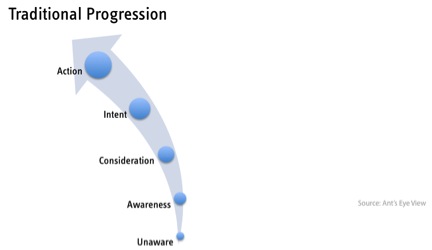
In many marketing organizations, the steps in the interaction between an organization and its customers have traditionally followed a predictable sequence, starting with “awareness” and culminating in some form of “action” on the part of the customer. It usually looks something like this:
Unaware: The customer does not know of the company and/or its offerings
Awareness: The customer has become aware of the company/offering
Consideration: The customer is considering the company as a potential solution to one of the customer’s current needs
Intent: The customer intends to purchase from the company
Action: The customer acts on the intention, and makes a purchase from the company
(Note the “action” might not always be a purchase, per se, but may be some other point-in-time interaction with the company, such as attending an event or downloading a whitepaper.)
There are a wide variety of situations where the model above accurately represents the sequence of events leading up to an individual transaction, from the company’s point of view. While the model above is well-understood and relevant in the transactional world, a social and relationship-driven world requires a complementary way of thinking.
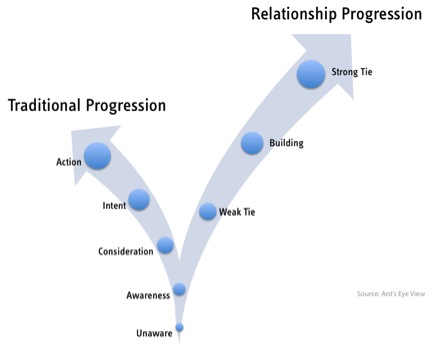
When building a business relationship, the sequence similarly starts with “awareness” (since one can not have a true relationship without being aware of the other party), and progresses until a “strong tie” is built between the two parties. The progression on the relationship side of the world looks something like this:
Unaware: The customer does not know of the company
Awareness: The customer has become aware of the company
Weak tie: The customer and company have developed a basic awareness of each other, and feel mild affinity toward each other
Building: Subsequent interactions mutually strengthen the relationship between the two parties
Strong tie: Both parties feel a strong affinity, and perhaps even a level of responsibility, toward each other
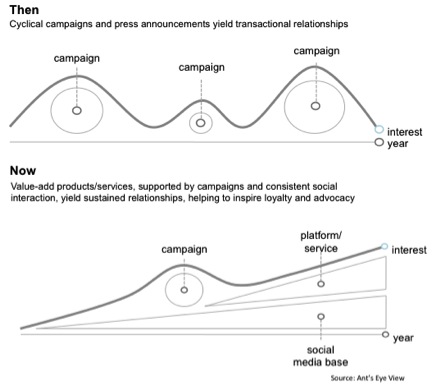
In building these relationships, we create a base from which activities can be launched. In doing so, we evolve from a campaign-based model to one that is “always on.” Visually, it looks something like the image below.
So, what’s the take-away? The key thing to note is that both types of interactions are needed in order to effectively compete. Campaigns are still needed in many cases, especially around point-in-time activities such as events and product launches. That said, having a strong set of relationship ties with customers can make those same campaigns even more effective, building upon the existing relationships to increase their reach and impact. Relationships become the base upon which campaigns become more effective.
The recent report, From Stretched to Strenghened, states that “the vast majority of [midmarket] CMOs believe there are three key imperatives that will enable them to respond to the marketing challenges in today’s complex world. They must understand and deliver value to empowered customers; create lasting relationships with those customers; and measure marketing’s contribution to the business in relevant, quantifiable terms.”
To this end, there are three things you can do today to begin to create lasting relationships with customers and expand the “base” illustrated above:
Identify your top twenty individual customers
Connect with them either on a community that your organization has set up, or on public sites such as LinkedIn, Facebook or Twitter
Read their contributions on a daily basis (it will only take a few minutes) and join in the conversation if appropriate
By taking the three steps above, you will invariably find that you will begin to build that base of relationships that will increase the effectiveness of all of your other customer-facing activities.
Sponsored post disclosure: This post was written as part of the IBM for Midsize Business program, which provides midsize businesses with the tools, expertise and solutions they need to become engines of a smarter planet
These are your best and most-loyal consumers. They are the 20% of the Pareto principle (roughly 80% of the effects come from 20% of the causes.) Reward them with early access, discounts and swag. They’ll let everyone know about their special treatment. Highlight and reward. Showcase fans of the week. Do be prepared in case a super fan is angry. These people may take the brand more seriously than you do and may react poorly to change. Know how to respond. Brands have made mistakes in social media — learn from them. Have a crisis plan in place. Inevitably, you’re going to mess something up and make the crowd angry. Be ready.
Do let them share. Make it super easy for fans to advocate on your behalf. Do track and optimize results. Utilize analytics to measure the results you’re getting from super fans or advocate marketing programs. With testing tools, you can see what approaches work best. Don’t pay super fans. Don’t give financial rewards or incentives to get them to recommend your brand or products. It’s inauthentic and can backfire. People who learn that they’ve been given a paid or incented recommendation are actually less likely to buy the recommended product or service, studies show.
Interestingly, Porter only really focuses on the “Benefits” part of the triangle. The other two components are as, if not more, important than the benefits you give to those influential advocates in the community.
Take, for example, the Aruba Networks MVP program (disclosure: Aruba is a client and we worked with them to develop this program). The Aruba MVP program contains all three components:
Identity – MVP members of the community can be easily identified by others, and each other. This adds a layer of visible, verifiable reputation to the program. Aruba does this via badges shown for the levels of their MVP program. (The Aruba program has three levels: MVP, MVP Expert and MVP Guru.)
Privileges – MVPs are able to participate in the community in ways that are unique to their level
Benefits – Yes, they do get some cool swag
As Porter notes in her article, MVPs and Superfans are elevated members of the tribe. As such, others who are new to the community need to be able to quickly and unambiguously recognize who the key voices in the community are. Similarly, because MVPs have contributed to the overall community during their involvement with it, it is important (as a good host) to recognize their contributions and enable them to easily share their passion for the organization with others.
“Social media is all about relationships. If you want to find people’s relationships, an address book is the best place to go. It’s like if you want to rob a bank, go where the money is.” – Joe Turow
There was a fantastic segment on NPR’s Fresh Air yesterday that featured Joseph Turow speaking with Terry Gross on how advertisers are tracking customers across the web, social networks and mobile. It’s most definitely worth a listen. I’ve linked both the audio segment as well as the transcript below.
Interview Highlights (excerpted from the NPR web site linked above)
On the categories advertisers use to track you online
“Most of them have to do with demographics like age and gender and income. Some of them have to do with where you live, which can be very specific to particular neighborhoods sometimes. Some of them are weird, like socially organic eaters, but that has to do more with how companies make inferences about how you act. … Go to a company called Acxiom on the Web. You will see a catalog of maybe 100 pages of the kinds of things that this company sells about all of us. They sell whether you look for diabetic stuff online, whether you’re interested in orthopedic products, whether you’ve gone on vacation. They will sell what kinds of credit cards you have. And all of this is perfectly legal, and it can be used for online targeting as well as offline targeting.”
On how apps can store and transmit information in your phone’s address book
“It remains to be seen how many companies took out and take out that data and what is done with them, but you can see that it could give you an enormous amount of stuff. … You can look at a person’s camera and actually turn it on if you wanted to. A person might notice that the camera’s on, but you could look at his friends or her friends and identify them if you wanted to, in a certain kind of world. You could look at the person’s photos, contact lists. That’s potentially the case with what people have been saying about the Apple iOS.”
On Twitter and other companies gathering information from people’s address books on their iPhones
“Social media is all about relationships. If you want to find people’s relationships, an address book is the best place to go. It’s like if you want to rob a bank, go where the money is.”
On Facebook
“The amount of money Facebook gets per user from advertisers is not nearly the amount of money that Google gets. But the potential is there, and that’s why Wall Street has been going after them.
“They gather everything that you do on Facebook. Facebook scarfs it all up. We know that Facebook has the ability and does target you on their website in an enormous number of ways. They don’t give your name to any of the advertisers — it’s all done anonymously. I’m not a fan of the distinction between anonymity and nonanonymity. … If you’re Joe Schmoe online or they know your real name or they give you an identification number — and so much of our lives is done online — in the end it doesn’t matter. You’re treated like a person who they know with all of the possible discriminatory activities we’ve talked about.”
On online media
“I would argue that the 20th century taught people that content is cheap. Because on television and radio it was free, in newspaper and magazines, they got huge amounts of stuff paying very little. And as a consequence, when the world starts changing and there’s a lot more competition because there’s no longer one place to get news in print, the notion of paying for a lot of people became anathema.”
On European privacy policies and an upcoming U.S. privacy policy
“They believe in privacy as [a] human right. And that’s the interesting thing about how [the upcoming] Commerce Department report is positioned: as a right. There are some advocates who don’t like what they see in the policy because they think it’s too loose. But the very fact that it’s called a right is interesting rhetorically. Some people would say they’re moving in the right direction.”
On data-mining and politics
“Politicians want to get votes. And they have begun to realize what consumer products companies realize: that if you get a lot of information about people, you can predict how they might act or what they might believe, even to the point [of thinking] ‘What kind of car do people who might vote Republican have vs. Democrats?’ And the more data points you have, the belief system is, the more likelihood that you can get on the right side of a person. So companies have evolved over the last few years that are essentially data-mining companies for various political organizations. Even the Obama campaign is perceived to be at the forefront of this stuff. If you go to their privacy policy, they take everything. When people give information about themselves for whatever reason on the Obama website, [the campaign] keeps it, they use it, they buy other information about you if they want. And on their privacy policy, it says they might share it with political organizations they consider conducive.”
With all of the hue and cry around “big data,” the forward thinking folks are actually looking the other way. Here’s the ‘graf that matters:
“Much the way powerful mobile devices store your biometric information and translate your language, personalized information filters and search engines will bring you only the information you want. “This will invert the premise of marketing,” Mr. Meyerson said. The phones “will start to be your advocate, recognizing what is near and dear to you and getting it. Instead of companies speaking to you, you will reach out to companies.” (emphasis added)
Although many of us are working in or with enterprises in a role related to connecting with customers, we need to do a shift in perspective. For right now, put on your “customer” hat; we all are customers, in addition to trying to connect with them. Through that lens, “good attention” is the type of attention you pay when something connects with you. It’s the type of attention to things you find interesting or engaging or intelligent or emotional. Conversely, “bad attention” is the attention that you pay, but you wouldn’t choose to if you had a better (or any) option.
Here are some examples of “good attention”
The attention you pay to any experience that you eventually tell a friend about
I struggled where to put the attention acts of “becoming a Fan” and “becoming a Follower” on this list. If you become a fan of a brand on Facebook because you like the brand, I think it’s at best a neutral. On the other hand, if you are forced to click “Like” in order to see a page’s content or to enter a one-shot contest as part of a campaign, that’s bad attention. It distorts and overloads the meaning of the word “Like” in such as way that is ultimately detrimental to an enterprise. The focus on “counting metrics” is almost always used as the starting point at measuring the impact of social engagement. But it can’t stop there.
Counting metrics are frequently used by enterprises at Stage 2 on the Social Engagement Journey. This is normal. Unfortunately, like high fructose corn syrup, counting fans and followers are the empty calories of customer engagement. They taste great at the time, but in the long run have a strong likelihood of causing damage. A focus on fan and follower counts ultimately leads to being caught in a bad attention trap.
So what can you do to move along the Journey?
Think about whether you are attracting good attention or bad attention from your engagement activities
Begin the transition from counting metrics to metrics that matter to both customers and your brand (like NPS)
Don’t be complacent, thinking that having two million fans on your Facebook page means that you’re doing a good job at building long-lasting customer relationships with those two million individuals. It doesn’t. (Do you know how many of those two million fans are current customers of your brand? If the answer is “no, we don’t know,” then recognize that you’re likely falling into the trap of bad attention.)
The confluence of the Super Bowl and its focus on immense ad spend, coupled with speaking at last week’s NetPromoter conference triggered a thought. Are there two kinds of attention (let’s call them “Good Attention” and “Bad Attention”), in the same way that there are two kinds of profits?
We know that there are two kinds of profits. Good profits are profits that fuel growth, and come from serving customers in such a way that they are willing to recommend your organization to others. Bad profits, conversely, are the types of profits where the customer feels extorted. Bad profits help make the quarterly number in the short run, but are unsustainable. Bad profits eventually eat away at the fabric of the company, by alienating its customers and demotivating its employees. An income statement can’t tell the difference between these two types of profits. But customers can.
Therefore, are there also two kinds of attention as well? It seems to me there are. “Bad attention” is interruptive. It’s the type of attention that is so costly, because it is so bad and inefficient. Think about popover ads, think about the Flash ads you block with AdBlocker, think about the “attention” you pay to the ad that starts blasting a tune as soon as you land on a page. Those are all ways of getting attention, but it’s bad attention.
Good attention is its opposite. Good attention is the attention you garner by virtue of going above and beyond. It’s the attention you earn by delighting someone, surprising them, amusing them, or triggering an empathetic emotion.
The ROI of good attention is orders of magnitude better than the ROI of bad attention. (In fact, it approaches infinity, if you really think about it.) Good attention is the attention that results in positive word of mouth, advocates, and the creation of promoters and defenders of your brand.
Good attention and bad attention are not functions of the communication channels being used between an organization and its customers. There are huge Super Bowl ads that attract good attention (think about last year’s Darth Vader commercial from VW – that was great). Similarly, there are 1:1 conversations that attract bad attention (and there is now an increasing amount of research on how to identify fake word-of-mouth).
Maybe we can classify some of these things. Are there examples of “good attention” and “bad attention” that you’ve seen recently?